
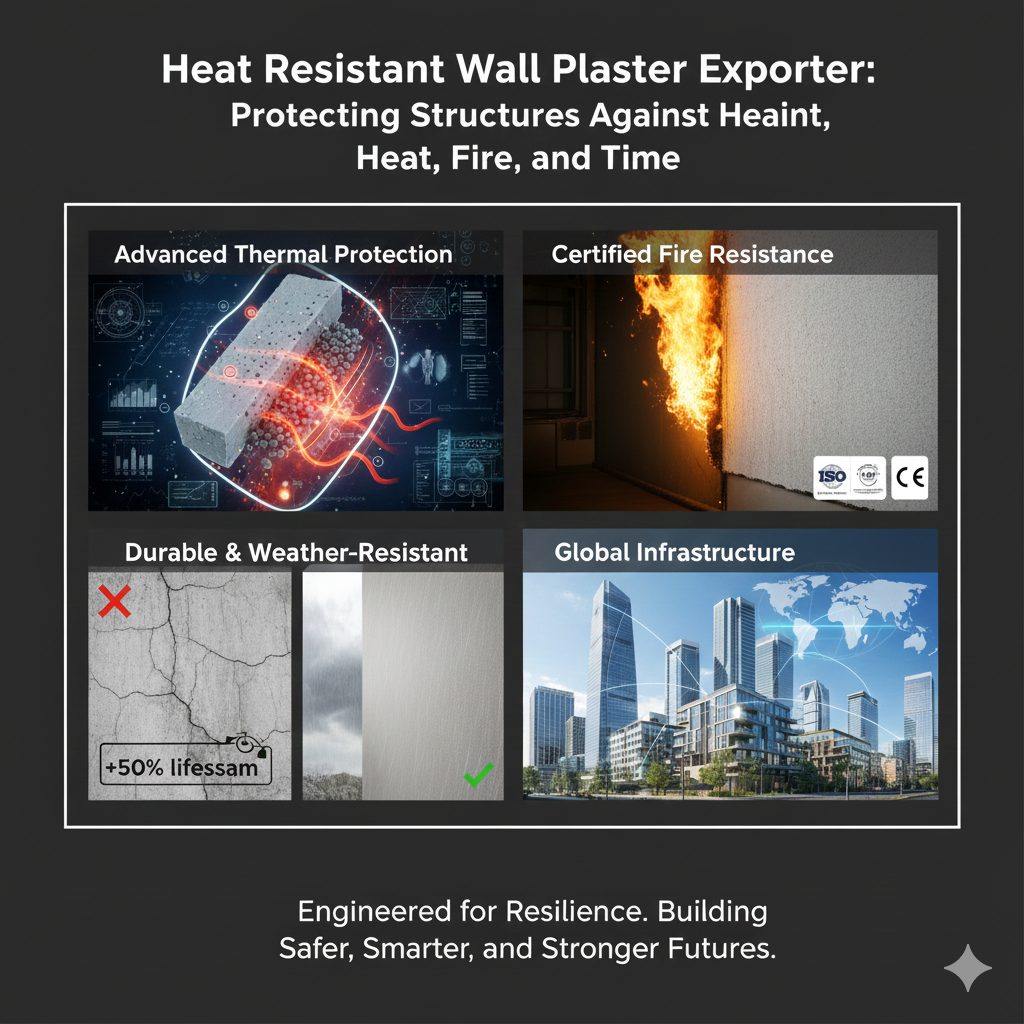
Heat Resistant Wall Plaster Exporter: Protecting Structures Against Heat, Fire, and Time
Walls in high-temperature environments do more than divide spaces—they endure constant thermal assault.
When paint blisters and concrete spalls under heat, the problem is structural, not cosmetic.
Heat resistant wall plaster acts as the first defense, preventing degradation and extending the lifespan of walls exposed to extreme heat.
1 | The Real Problem: When Heat Destroys Wall Integrity
Factories, commercial kitchens, and power stations share one silent enemy—thermal fatigue.
Continuous heating and cooling cycles cause micro-expansion and shrinkage, leading to:
-
Surface cracking and flaking, weakening structural layers.
-
Loss of adhesion, especially near metal or furnace areas.
-
Moisture ingress, accelerating corrosion behind the plaster.
-
Paint discoloration and coating failure from radiant heat.
Once these symptoms appear, repair costs multiply—and conventional plasters simply cannot withstand repetitive heat cycles above 80°C.
2 | What Makes a True Heat Resistant Plaster
Heat-resistant plaster is a composite engineered for thermal endurance, mechanical adhesion, and fire resistance.
Instead of relying on basic cement, YUNYAN’s export-grade formulation integrates alumina binders, heat-resistant silica, and polymer modifiers to ensure stability under extreme conditions.
| Core Ingredient | Function | Technical Benefit |
|---|---|---|
| High-Alumina Cement | Thermal binder | Maintains structure up to 600°C |
| Expanded Silica Aggregate | Lightweight insulation | Reduces surface temperature transfer |
| Reinforcing Fibers | Crack control | Withstands thermal stress cycles |
| Polymers & Additives | Flexibility | Prevents delamination on concrete or brick |
| Anti-Efflorescence Agents | Chemical stability | Keeps wall surface clean and uniform |
Performance benchmarks (YUNYAN laboratory data):
-
Thermal resistance: up to 600°C continuous exposure
-
Adhesion: ≥ 0.4 MPa (on concrete substrate)
-
Linear shrinkage: ≤ 0.08%
-
Density: 1.2–1.4 g/cm³
3 | Comparison: Standard Plaster vs. Heat Resistant System
| Feature | Standard Wall Plaster | Heat Resistant Plaster |
|---|---|---|
| Temperature Resistance | ≤ 70°C | ≥ 600°C |
| Thermal Expansion Control | Poor | Stable under cycles |
| Adhesion Strength | Decreases with heat | Enhanced by polymer network |
| Moisture Resistance | Low | Hydrophobic, anti-efflorescence |
| Service Life | 5–8 years | 15+ years |
This makes heat-resistant systems indispensable in industrial kitchens, furnaces, generator rooms, and exterior sun-exposed façades.
4 | Inside YUNYAN’s Export Manufacturing and Quality Process
Each batch of YUNYAN’s plaster is formulated to meet ASTM E84 and EN 998-2 standards for fire resistance and durability.
Manufacturing Workflow:
1️⃣ Material Blending: Automated ratio dosing with ±0.5% precision.
2️⃣ Thermal Test Simulation: 24h heat-aging cycle at 550°C to test shrinkage.
3️⃣ Adhesion Verification: Tested on concrete, AAC block, and brick surfaces.
4️⃣ Moisture-Proof Packaging: 25kg bags sealed under nitrogen flushing.
5️⃣ OEM Export Support: Custom branding, palletized export packaging, and SDS documentation for EU & GCC regions.
YUNYAN’s technical team also tailors formulations for industrial, hospitality, and infrastructure projects, ensuring compliance with diverse climate and fire codes.
5 | Application Scenarios: Beyond Industrial Settings
| Project Type | Typical Problem | Recommended YUNYAN Solution |
|---|---|---|
| Commercial Kitchens | Heat and oil vapors | Polymer-modified heat resistant plaster |
| Power Stations / Boiler Rooms | Radiant heat & corrosion | Alumina-based high-temp plaster |
| Façade Exposed to Sunlight | UV and heat-induced cracking | Reflective heat resistant plaster |
| Tunnels & Substations | Flame retardancy | Fiber-reinforced fire-resistant render |
| Manufacturing Plants | Continuous operation zones | Quick-dry, abrasion-resistant system |
In each scenario, the plaster serves both thermal shield and structural armor, maintaining stability and aesthetic integrity under stress.
6 | Application Process: Industrial Precision
| Step | Process | Key Control |
|---|---|---|
| 1. Base Preparation | Remove weak material & clean substrate | Moisture ≤ 6% |
| 2. Mixing | Add 22–25% water, mix 3–5 min | Ensure uniform dispersion |
| 3. Application | Apply in 2–3 coats (max 20mm total) | Allow partial set between layers |
| 4. Curing | Air cure 24h, avoid forced drying | Prevent cracking |
| 5. Finish | Optional paint or ceramic coat | Only after full curing |
When properly applied, heat-resistant plaster not only withstands temperature extremes but also provides sound insulation and fire protection—two critical requirements for modern facilities.
7 | Key Advantages for Export Clients
-
Versatile Substrate Compatibility — Concrete, AAC, brick, or steel.
-
High Thermal Stability — No deformation even under cyclic heating.
-
Ease of Transport & Storage — Moisture-proof export packaging.
-
Custom OEM Branding — Localized labeling and documentation support.
-
Energy and Safety Compliance — Certified under ASTM, EN, and ISO standards.
These attributes make YUNYAN’s products a trusted choice for construction distributors, infrastructure developers, and industrial OEM clients worldwide.
Stronger Walls for Hotter Environments
In regions where heat is relentless, wall materials must do more than look good—they must endure.
YUNYAN’s heat resistant wall plaster offers builders, contractors, and distributors a scientifically engineered coating that performs where ordinary plasters fail.
For bulk export inquiries, OEM production, or regional distribution partnership, visit YUNYAN’s official website or contact our global export team via contact page.
Build protection that stands firm against fire, heat, and time.