
Thermal Insulation Plaster Supplier: Energy-Saving Walls for Modern Construction
When comfort, cost, and carbon reduction converge, thermal insulation plaster becomes more than just a coating—it’s a building technology.
Whether in tropical climates battling heat gain or cold regions minimizing heat loss, a high-performance insulation plaster creates the invisible layer that defines indoor comfort and energy efficiency.
1 | When Walls Waste Energy
Even the strongest concrete wall is a poor thermal regulator.
Without insulation, temperature transfer through the wall can account for 35–45% of building energy loss, leading to:
-
Unstable indoor temperatures and condensation.
-
Excessive HVAC load and high electricity bills.
-
Cracks and damp spots from thermal stress cycles.
-
Shorter paint and façade coating lifespans.
Energy codes worldwide—from EU EPBD to China’s GB50176—now require improved wall insulation performance, making insulation plaster systems an essential part of modern construction.
2 | The Science Behind Insulation Plaster
A true insulation plaster doesn’t just coat—it creates a thermal barrier through microcellular structure and low-conductivity fillers.
| Core Component | Role | Performance Effect |
|---|---|---|
| Expanded Perlite / EPS / Vermiculite | Lightweight aggregate | Reduces thermal conductivity ≤ 0.08 W/m·K |
| Cementitious Binder | Mechanical structure | Ensures high adhesion and dimensional stability |
| Polymer Modifier | Flexibility & crack control | Prevents shrinkage under temperature cycles |
| Hydrophobic Additive | Moisture repellence | Protects from damp and mold |
| Glass Fiber Reinforcement | Strengthening | Improves crack resistance and cohesion |
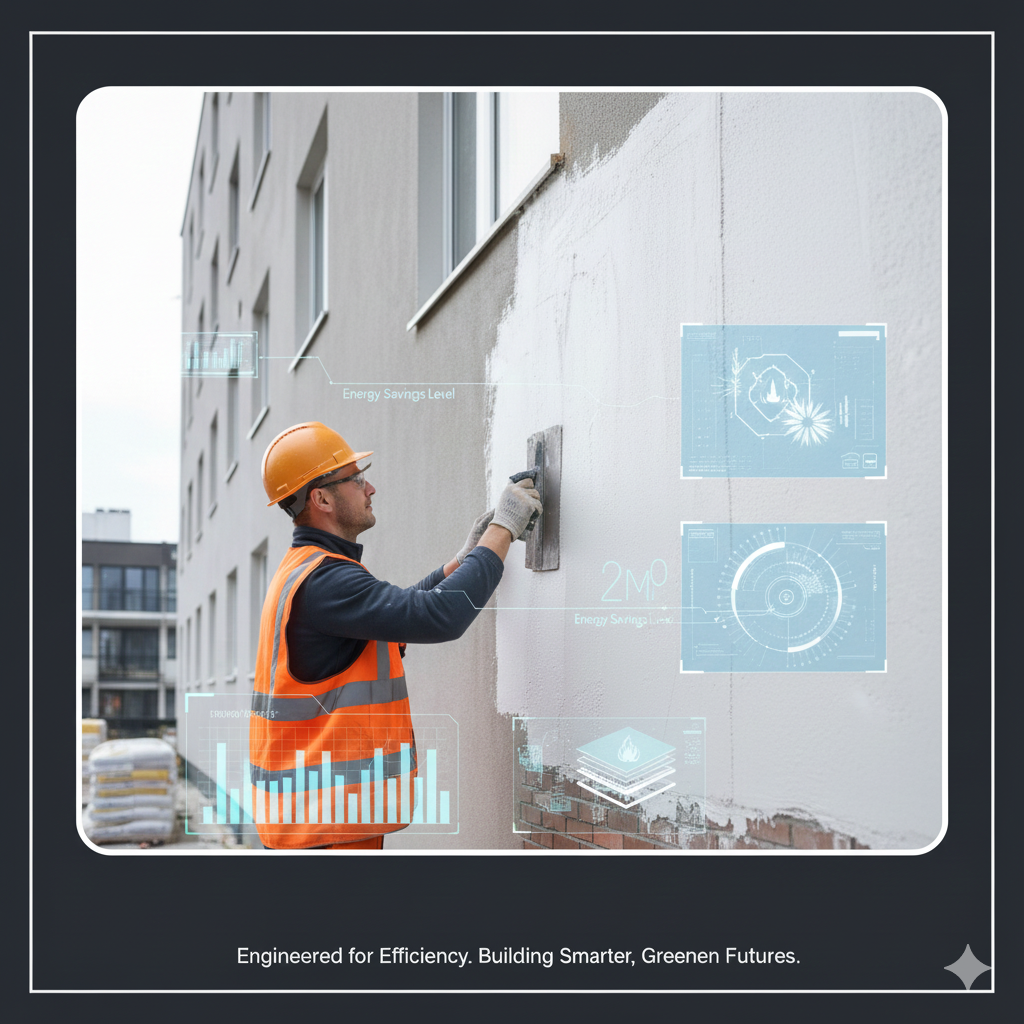
The result is a breathable, light, and high-performing thermal layer—seamlessly applied with trowel or spray for both new builds and retrofits.
3 | Traditional Insulation vs. Integrated Plaster Systems
| Feature | Traditional EPS Board System | Thermal Insulation Plaster |
|---|---|---|
| Installation Steps | Multi-layer (board, adhesive, mesh, render) | One-step application |
| Crack Resistance | Requires mesh layer | Built-in flexibility |
| Adhesion Strength | Depends on adhesive | ≥ 0.3 MPa directly to wall |
| Breathability | Limited (closed-cell foam) | Excellent vapor permeability |
| Maintenance | Frequent repainting | Long-term surface stability |
| Thermal Performance | λ = 0.035–0.045 | λ = 0.05–0.08 (continuous layer) |
This simplicity and durability make insulation plaster the preferred solution for large-area façades and rapid construction projects.
4 | YUNYAN’s Material Engineering and Quality Control
YUNYAN’s thermal insulation plaster is manufactured under strict ISO 9001 and EN 998-1 standards for consistent performance and long-term stability.
Production Highlights:
1️⃣ Precision Mixing: Computer-controlled dosing ensures ±0.5% consistency.
2️⃣ Thermal Conductivity Testing: Each batch verified using ASTM C518.
3️⃣ Moisture Control: Materials packed in moisture-proof 25kg bags.
4️⃣ R&D Customization: Formulations for hot-humid, cold, and coastal climates.
5️⃣ OEM Flexibility: Available for private label with branding and TDS support.
Performance Metrics:
-
Thermal conductivity ≤ 0.08 W/m·K
-
Compressive strength ≥ 3.5 MPa
-
Bond strength ≥ 0.3 MPa
-
Water absorption ≤ 6% after 24h
5 | On-Site Application and Performance Workflow
| Step | Process | Key Control |
|---|---|---|
| 1. Surface Prep | Clean base wall, remove dust/oil | Moisture ≤ 6% |
| 2. Primer Application | Improves bonding | Apply thin adhesion coat |
| 3. Mixing | Add 25–27% water, mix evenly | Avoid air entrapment |
| 4. Application | Spray or trowel 10–20mm per layer | Use mesh for multi-layer systems |
| 5. Finishing & Curing | Keep moist 48h | Protect from direct sun |
In warehouses, villas, or high-rise façades, a well-executed insulation plaster creates a continuous thermal envelope that reduces energy consumption year-round.
6 | Application Scenarios Across Climate Zones
| Region Type | Challenge | YUNYAN Solution |
|---|---|---|
| Cold Regions | Heat loss through wall structure | Fiber-reinforced flexible plaster |
| Tropical Zones | Solar heat and humidity | Hydrophobic lightweight plaster |
| Coastal Projects | Salt & corrosion | Polymer-modified water-resistant plaster |
| Industrial Facilities | Mechanical vibration | High-adhesion thermal mortar |
| Green Building Projects | Low carbon target | Perlite-based eco formula |
Whether applied on concrete, AAC block, or brick, the system ensures strong adhesion and continuous insulation even in challenging environments.
7 | Sustainability and Compliance Advantages
YUNYAN’s thermal insulation plaster supports:
-
LEED and BREEAM green certifications
-
Reduced CO₂ footprint via extended building life
-
VOC-free and recyclable composition
-
Labor efficiency—single-step system reduces project time by 30–40%
As building codes shift toward net-zero performance, such integrated insulation systems will define the future of wall construction.
8 | Avoiding Common Installation Errors
-
Mixing ratio errors cause poor thermal stability.
-
Skipping primer leads to delamination.
-
Uneven layer thickness causes cold bridges.
-
Rapid drying under direct sunlight weakens adhesion.
Following YUNYAN’s TDS and applying in recommended temperature ranges ensures optimal curing and insulation performance.
A Smarter Way to Build Energy-Efficient Walls
Walls should do more than stand—they should protect, insulate, and endure.
With YUNYAN’s thermal insulation plaster, builders and contractors gain a single-layer, high-performance wall system that meets energy standards and reduces lifecycle costs.
For global distribution or OEM partnership, visit YUNYAN’s official website or connect with our experts via contact page to explore product specifications and technical support.