
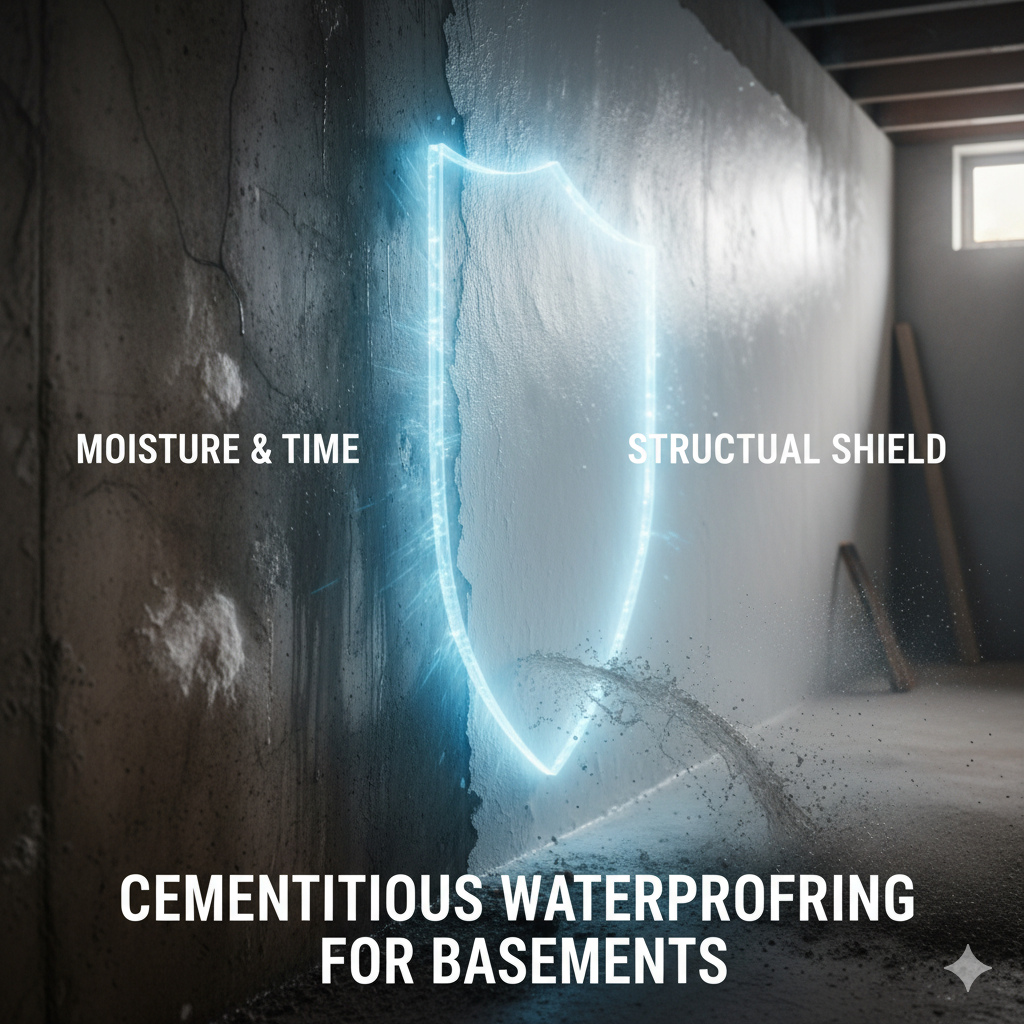
Cementitious Waterproofing for Basements: The Structural Shield Against Moisture and Time
Basements are under constant hydrostatic stress. Groundwater pushes against every square inch of concrete, and any minor crack becomes a channel for moisture migration. Over months, this leads to efflorescence, rusted reinforcement, and interior dampness.
That’s where cementitious waterproofing for basements stands apart—a mineral-based, polymer-reinforced coating that becomes an integral part of the concrete structure rather than a detachable surface layer.
1 | The Real Enemy Beneath Every Building
Typical basement leaks originate from predictable yet critical issues:
-
Cold-joint seepage between slab and wall connections.
-
Capillary rise through pores and hairline cracks.
-
Negative-side infiltration, when water pressure acts from the outside inward.
-
Hydrostatic stress that pushes moisture through microvoids.
Once water enters the matrix, carbonation and chloride reactions accelerate, reducing the lifespan of the structure.
2 | How Cementitious Waterproofing Works
Unlike surface sealants, cementitious coatings bond chemically with the concrete substrate. When hydrated, active ingredients react with free lime to form insoluble crystalline structures that fill pores and micro-cracks.
Core Mechanism:
Hydration Reaction → Crystalline Formation → Pore Blocking → Breathable Waterproof Barrier.
This internal sealing process ensures the coating remains vapor-permeable, allowing the structure to “breathe” while resisting liquid water penetration.
3 | Material Composition and Performance Comparison
| Component | Function | Typical Performance |
|---|---|---|
| Portland cement | Base binder for matrix formation | ≥ 25 MPa compressive strength |
| Quartz fillers | Improve density & abrasion resistance | Surface hardness > 5H |
| Polymer modifier | Adds elasticity and crack bridging | Elongation > 80% |
| Crystalline agent | Reacts with free lime to seal pores | Water absorption < 0.1 kg/m²·h |
| Hydrophobic additives | Prevent capillary uptake | Contact angle > 110° |
A high-quality system must comply with EN 14891 (Class CM O2) and ASTM C580 standards, ensuring long-term waterproof integrity even under negative-side pressure.
4 | Cementitious vs Bituminous Systems: A Practical Comparison
| Property | Cementitious System | Bituminous Membrane |
|---|---|---|
| Base material | Mineral + polymer | Petroleum-based |
| Adhesion to substrate | Chemical bond | Mechanical only |
| Breathability | Yes | No |
| Toxicity / VOC | Low | High |
| Crack bridging | Moderate (≤1 mm) | Limited |
| Application | Brush / spray | Torch-applied |
| Suitability | Interior & exterior | Mainly exterior |
This is why cementitious systems dominate underground and basement applications, where structural bonding and vapor control are essential.
5 | Installation Best Practices for Long-Term Sealing
Surface Preparation:
-
Remove laitance, dust, and grease.
-
Repair cracks with non-shrink mortar.
Mixing & Application:
-
Combine powder and liquid components per manufacturer ratio.
-
Apply two to three coats at ~1.5 kg/m² each.
-
Maintain curing humidity for 48–72 hours.
Testing & Verification:
-
Perform adhesion pull-off test (≥ 1.0 MPa).
-
Conduct flood test after full curing.
These steps are the difference between a sealed structure and a leaky rehab project.
6 | Application Zones and System Recommendations
| Area | Recommended System | Key Benefit |
|---|---|---|
| Exterior wall | Two-component polymer cementitious | Flexibility + durability |
| Interior wall | Crystalline cementitious | Self-healing microcracks |
| Floor slab joint | Fiber-reinforced cementitious with sealant band | High tensile resistance |
| Lift pit / tunnel | Negative-side cementitious coating | Withstands pressure from outside |
Each system can be enhanced with fiber reinforcement or PU topcoat depending on moisture load.
7 | Inside YUNYAN’s Factory: Precision Behind Every Bag
A true waterproofing manufacturer is defined by its process discipline:
-
Automated batch weighing to ensure mix consistency.
-
Curing simulation under variable humidity.
-
UV and hydrostatic aging tests.
-
Low-VOC polymer formulation for safe underground use.
YUNYAN operates its own R&D and testing lines to verify performance under hydrostatic pressure up to 1.5 MPa—guaranteeing stability for decades.
Sealing Basements Before Problems Begin
A dry basement is not achieved by luck—it’s built into the structure.
Cementitious waterproofing offers a chemical barrier that breathes with concrete while blocking water intrusion for life.
To explore data sheets and project-tested formulas, visit YUNYAN’s official website.
For custom formulations or bulk orders, reach our technical team through the contact page—and build your next foundation on certainty.